written by Amelia Swank
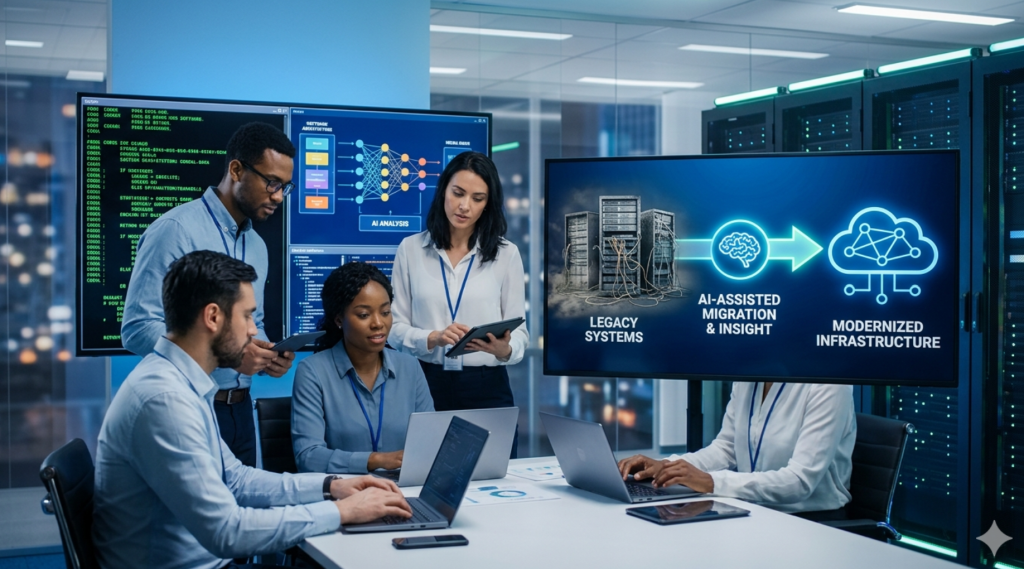
Many organizations still rely on systems built a decade or more ago to run core operations. Those systems may still function, but they make change slower, integration harder, and updates riskier than they should be. Legacy system modernization is the process of improving or replacing outdated technology so it can support current business, security, and integration needs.
The challenge has never been awareness; leadership knows the tech is old. The challenge has always been execution. For years, enterprise legacy modernization meant a “rip and replace” strategy, a terrifying prospect that usually results in massive budgets and high failure rates.
AI is changing that trajectory. It gives teams a more practical way to understand legacy code, uncover hidden dependencies, reduce analysis effort, and make modernization decisions with more confidence. And the need is practical, not theoretical. In McKinsey’s research, leaders cite integration with existing systems as the biggest barrier to scaling AI-native operations, at 42 percent, ahead of resistance to change at 41 percent.
Let’s see how organizations can change this narrative with AI.
How Delayed Legacy Migration Slows Change, Breaks Integration, and Increases Risk
In the world of IT, delay is not a neutral act. When modernizing legacy systems keeps getting pushed back, the impact does not stay inside the IT stack. It ripples outward, affecting delivery speed, integration capability, compliance readiness, operating cost, and overall business responsiveness.
In practice, that drag usually shows up in three ways: slower change, harder integrations, and greater business risk. If you aren’t actively engaging in legacy software modernization, you aren’t standing still; you’re falling behind.
How Old Systems Slow Down Change
Legacy systems rarely become a problem because they are old; they become a problem because they are opaque. The real issue is accumulated complexity: brittle logic, hard-coded rules, incomplete documentation, and years of “quick fixes” added to preserve continuity. As a result, even minor changes can create outsized risk because teams are never fully certain what else might break.
That slows development in practical ways. Testing becomes more cautious and manual because automated test suites often don’t exist for 15-year-old COBOL, a language that still processes USD 3 billion in daily commerce per IBM. And this is just one example. Release cycles get longer. Teams spend more time preserving current behavior than improving it. Eventually, the technology environment starts setting the pace of change for the business, rather than the business driving the technology.
Why Integrations Become Harder Over Time
The problem becomes more visible when legacy systems need to connect with modern cloud applications, analytics environments, automation platforms, and third-party APIs. Older systems were not built for this level of interoperability, creating integration challenges that grow as the surrounding digital ecosystem becomes more fragmented. They speak the language of batch processing and flat files, while the modern world speaks in real-time streams and JSON.
As the surrounding ecosystem evolves, the effort required to connect legacy platforms keeps increasing. Organizations end up creating custom connectors, temporary workarounds, and one-off interface layers just to keep processes moving. Those fixes may solve the immediate problem, but they also add cost, complexity, and new dependency risks. Without a cohesive strategy for modernizing legacy applications with AI, these workarounds eventually become a “spaghetti” architecture that is impossible to maintain.
How Delay Increases Business Risk
The longer modernization is deferred, the greater the risk extends beyond engineering. Slower release cycles reduce responsiveness to market shifts. Security and compliance become harder to manage as standards evolve and vendors stop supporting older frameworks. Maintenance costs rise, while system knowledge becomes concentrated in a small number of long-tenured specialists who are eventually going to retire.
At that point, the issue is not just technical debt. It becomes a business resilience problem. Traditional responses, such as full rewrites, often carry high cost and execution risk. What AI in legacy system modernization changes is not the need to modernize, but the ability to approach it with better insight, stronger prioritization, and more controlled execution.
Three Ways to Modernize Legacy Systems Without Disrupting Live Operations
Not every legacy system needs a full rebuild. In many cases, the better option is the one that aligns with business urgency, budget, and operational tolerance. Legacy system modernization with AI supports that decision by helping teams move in a targeted way rather than forcing an all-or-nothing choice.
1. Augment First: Wrap and Extend
Sometimes the most practical move is not to replace the legacy core immediately, but to build a modern layer around it. This is a key part of legacy system automation using AI, where you improve how users access and interact with the system without forcing immediate change to the underlying platform.
By using AI to build intelligent wrappers or intelligent process automation (IPA) layers, you can bridge the gap between old data and new interfaces. From a business standpoint, this often delivers the fastest time-to-value with the least disruption. It also creates a controlled transition path, allowing teams to standardize access patterns and validate modernization priorities before touching the core application.
2. Analyze Before You Act: AI-Assisted Discovery
In many organizations, the first modernization problem is the lack of visibility. Teams often do not have a reliable picture of dependencies, code quality, or risk concentration. This is where the benefits of AI in legacy system transformation truly shine.
AI-assisted discovery gives stakeholders a clearer basis for prioritization. AI tools can scan large codebases, map dependencies, generate missing documentation, and summarize module functions. This allows you to accurately calculate the cost of legacy modernization using AI by knowing exactly what is under the hood before the project starts. Service partners can then turn those findings into a phased transformation roadmap instead of leaving internal teams with analysis paralysis.
3. Migrate Incrementally: The Strangler Fig Pattern, Supercharged
Some systems are too critical to replace in one move, but too restrictive to leave untouched. The Strangler Fig pattern works by gradually replacing legacy components with modern equivalents while keeping the broader system operational.
Legacy system migration with AI makes this model more practical by assisting with:
- Code Refactoring: Automatically identifying and cleaning up “dead” code.
- Test Generation: Creating automated tests to ensure the new system matches the old system’s logic.
- Regression Detection: Ensuring that the migration hasn’t broken critical business rules.
Overcoming the Hurdles: Challenges in Legacy System Modernization with AI
AI can make legacy modernization more practical, but it is not a shortcut that removes the complexity of legacy estates. Older systems often contain undocumented business rules, tightly coupled modules, obsolete dependencies, and years of exception handling that are difficult for AI tools to interpret correctly. There are also real governance concerns to manage, especially when source code, system logs, or business data cannot be exposed.
Another challenge is reliability. AI can help generate documentation, identify dependencies, suggest refactoring paths, and accelerate test creation, but its outputs still need careful validation. In legacy environments, a recommendation may look technically sound while missing a hidden dependency, misreading a business rule, or introducing logic that never existed in the original system. That makes architectural context, disciplined prompting, and technical review essential to using AI safely in modernization work.
This is why many organizations choose to hire AI developers for legacy systems who understand both the old-world logic and the new-world tools. You need people who can validate AI outputs, catch edge-case failures, and ensure that enterprise AI modernization use cases solve real business problems rather than just producing cleaner-looking code that fails under production conditions.
Legacy System Modernization Isn’t a Project. It’s a Strategy.
There is no single best path for modernizing legacy systems. The right approach depends on system criticality, business urgency, available budget, and internal delivery capability. What matters most is not choosing the most ambitious path, but choosing the one that reduces drag and protects continuity.
A practical place to begin is simple: identify the one system your team avoids touching because it feels too risky. In many organizations, that is where the cost of delay is already highest. By devising a thoughtful AI-powered modernization strategy or by working with professional legacy system modernization service providers, you can turn that “untouchable” system back into a competitive advantage. The goal isn’t just to be “modern”; it’s to be agile enough to handle whatever comes next, whether that’s a cloud migration, an AI integration layer, or a real-time analytics stack.

Author Bio :
Amelia Swank is a seasoned Digital Marketing Specialist at SunTec India with over eight years of experience in the IT industry. She excels in SEO, PPC, and content marketing, and is proficient in Google Analytics, SEMrush, and HubSpot. She is a subject matter expert in Application Development, Software Engineering, AI/ML, QA Testing, Cloud Management, DevOps, and Staff Augmentation (Hire mobile app developers, hire WordPress developers, and hire full stack developers etc.). Amelia stays updated with industry trends and loves experimenting with new marketing techniques.