
written by: Bret Larsen
Most sales teams have a forecasting process. The problem is that for a lot of them, it’s less of a process and more of a routine. Everyone submits a number, someone adjusts it based on gut feel, and leadership presents it upstairs with more confidence than the data actually supports.
That works until the team misses their number. When it stops working, you face missed quarters, scrambled budgets, and uncomfortable conversations about what went wrong.
If your revenue predictions are still coming from spreadsheets, half-updated CRMs, and rep submissions that everyone privately doubts, your forecasting process is just guessing with extra steps. Dedicated sales forecasting software exists to fix exactly that. Let’s find out why businesses need these forecasting tools and how to choose the right ones.
The Forecasting Problem Is More Common Than You Think
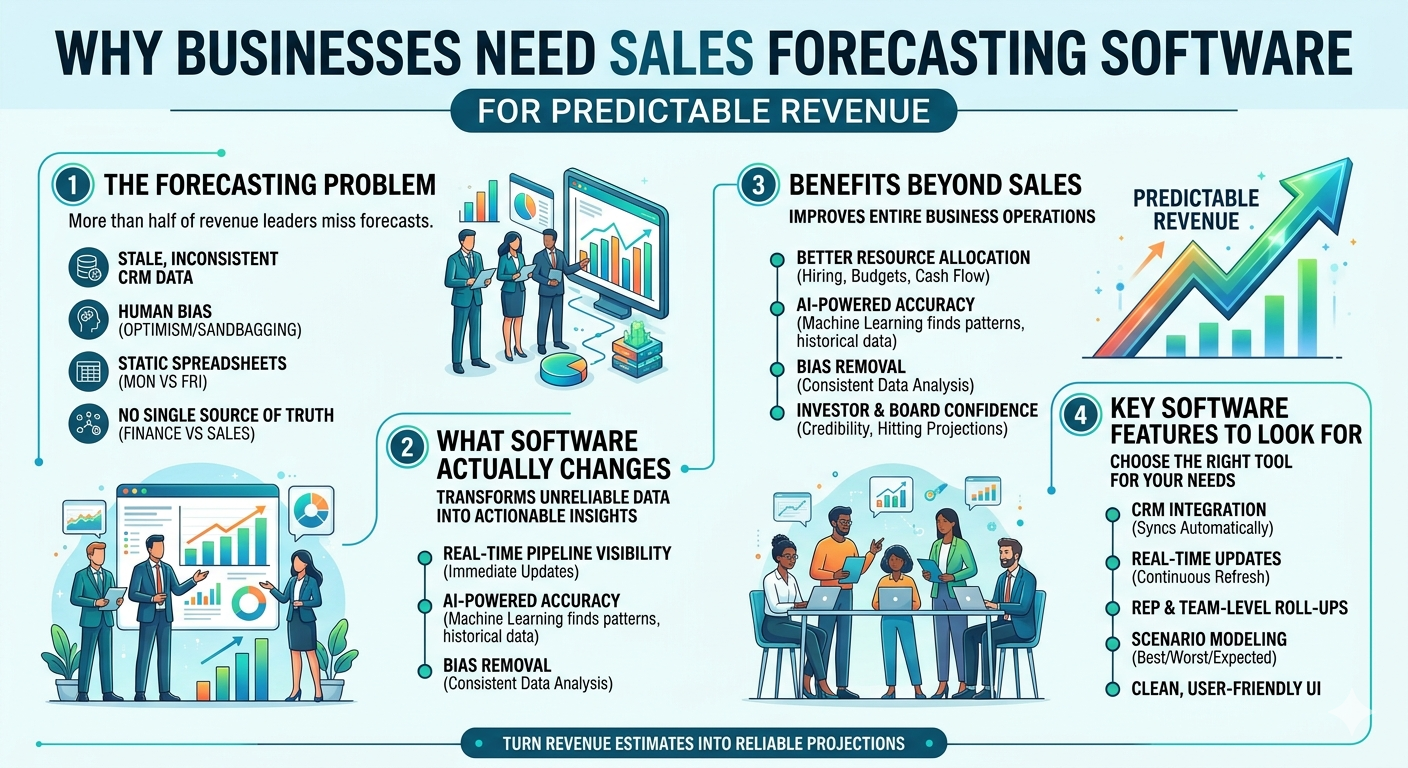
More than half – 55% of mid-market companies missed their forecast repeatedly between 2024 and 2026. And the gap between projected and actual wasn’t always rounding error territory. This keeps happening because the tools most teams rely on weren’t built for the complexity modern pipelines actually involve. There are a few recurring reasons businesses struggle here:
- Reps update their CRM inconsistently, which means the data feeding the forecast is stale or incomplete before anyone even looks at it.
- Human bias distorts the numbers. Optimistic reps log deals as committed too early, and cautious ones sandbag to look safe at quarter-end.
- Spreadsheets don’t update in real time, so a forecast built on Monday is already partially wrong by Friday.
- There’s no single source of truth. Finance has one number, sales has another, and nobody’s fully confident in either.
The result is a forecast that feels more like a negotiated guess than a reliable projection. Sales forecasting software like Chief is built specifically for turning unreliable, patchwork revenue estimates into actionable insights that the whole business can actually plan around.
What Sales Forecasting Software Actually Changes
Reliable sales forecasting software doesn’t just automate your existing spreadsheet; it helps you fundamentally change the inputs, the process, and the output.
Real-Time Pipeline Visibility
Your Monday forecast shouldn’t be wrong by Wednesday, but with manual processes, it usually is. Modern sales forecasting tools stay connected to your CRM and update as things actually happen. A deal goes dark on Tuesday afternoon and the forecast reflects it by Tuesday afternoon, not during the next weekly review when it’s already affected three other decisions downstream.
That gap between when something changes and when you find out is where most forecasting damage actually happens.
AI-Assisted Accuracy
Most enterprise-grade forecasting tools now use AI and machine learning to identify patterns that humans miss. Traditional forecasting can achieve only 75% accuracy. But according to research, AI can reduce forecasting errors by 20-50%, which helps businesses to make more targeted operational strategies. They look at:
- Deal age and progression speed
- Historical close rates by rep, product, and territory
- Engagement signals from email and call activity
- Seasonal trends and pipeline coverage ratios
The output is a forecast built on what the data actually shows, not what the sales team wants to believe.
Bias Removal
Sales reps are human. Some are eternal optimists who mark deals as committed the moment a prospect sounds warm on a call. Others deliberately lowball their numbers so they look good at quarter’s end. Neither version reflects reality, and there’s no manual process that reliably catches it. Software doesn’t have good weeks and bad weeks. It reads the data the same way every single time, which is the only way to get a number you can actually trust.
Benefits of Forecasting Software Beyond Sales
Sales forecasting gets framed as a sales problem, but the downstream effects touch every department.
Better Resource Allocation
Bad forecasts don’t just affect the sales meeting; they ripple. You hire ahead of revenue that never arrives, or you hold off on headcount and miss the window to build the needed capacity. Every major operational decision – from hiring, to spending, to territory planning – sits downstream of the forecast. With data-driven revenue forecasting, you get a clear picture of upcoming cash flow and can make informed decisions accordingly.
Cross-Functional Alignment
Finance needs the number to plan budgets. Marketing needs it to time campaigns. Operations need it to manage capacity. When sales produces a forecast that everyone trusts, those teams stop working from different assumptions and start planning from the same foundation.
Investor and Board Confidence
For businesses with external stakeholders, forecast accuracy is a credibility signal. Consistently missing projections – even when the business is performing reasonably well – erodes confidence fast. Consistently hitting the numbers does the opposite.
Signs You Need to Step Up to Dedicated Forecasting Systems
Not every business needs enterprise forecasting software on day one. But most growing teams hit the ceiling of their manual process faster than they expect. A few signs it’s time to upgrade to sales forecasting software are:
- Your forecast accuracy varies wildly quarter to quarter with no clear reason why.
- Finance and sales are regularly presenting different revenue numbers.
- You’re making hiring or budget decisions based on numbers nobody fully believes.
- CRM data quality is poor because reps don’t update it consistently.
- You have no early warning system when a quarter is heading off track.
If two or three of those sound familiar, the issue isn’t going to fix itself with better spreadsheet discipline.
What to Look For in a Sales Forecasting Tool
Not all sales forecasting platforms are the same, and choosing the right one can make a big impact on your revenue. The features of forecasting software that actually matter for most businesses are…
- CRM integration: It should sync automatically, not require manual exports.
- Real-time updates: Data should refresh continuously, not on a weekly schedule.
- Rep and team-level roll-ups: You need to see the forecast at every level, not just the aggregate.
- Scenario modeling: Reviewing best/worst/expected scenarios makes planning more effective.
- User friendliness: A tool nobody uses is worse than no tool at all.
The Bottom Line: Sales Forecasting Software Makes Revenue Predictable
Businesses usually underfund forecasting until a bad quarter forces the conversation. By then, the missed hire, the blown budget, and the painful board meeting have already happened.
The teams that stay ahead of the curve aren’t smarter or luckier; they build systems and processes that actually reflect how their pipeline moves. With accurate data, effective tooling, and discipline, you can actually rely on your forecast.
Author Bio: Bret Larsen (https://www.linkedin.com/in/bretalarsen/) is the Founder & CEO of Chief (https://www.getchief.com/), a proactive deal execution platform for growth-stage B2B sales teams. He previously co-founded eVisit, a virtual care platform that raised over $75M (Series B led by Goldman Sachs), earned the solo Leader designation in the Forrester Wave™ for Virtual Care Platforms, and grew revenue 400% over three years.
A two-time Ernst & Young Entrepreneur of the Year Finalist and Titan 100 CEO, Bret has spent his career building GTM systems for companies that need enterprise results (but don’t have enterprise resources or timelines). He writes about deal execution, revenue operations, pipeline hygiene, and what it actually takes to build a predictable sales machine. Bret is based in Utah.